My favorite filmmakers are my favorite filmmakers because they give me some new gift every time I revisit their work. So I find myself never able to stick with a permanent choice for My Favorite Film. It might be
"Kagemusha" (1980) this month (I prefer the leaner American release version, I feel embarrassed to say), next month
"Seven Samurai" (1954).
"The Birds" (1963) this month, next month
"North By Northwest" (1959). Usually, I will say that
"Black Narcissus" (1947) or
"Stairway To Heaven" (1946) (aka "A Matter Of Life and Death") are my
Powell/
Pressburger films du mois. However, this
mois, the movie in the #1 Archers spot is certainly
"The Life and Death of Colonel Blimp" (1943). "Blimp" is a film made with one foot in WWII-era British propaganda and the other wedged in between Cervantes' "Don Quixote" and Truffaut's
"Jules and Jim" (1962). It spans 40 years of a British soldiers life and covers everything from love to humiliation, honor to stupidity, idealism to self-delusion, Germany to England. And it features Deborah Kerr playing not just one mouth-watering female lead, but three.
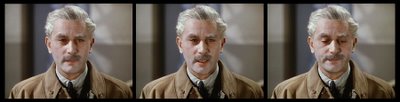
The monologue below comes from our pompous hero's best friend, the realist Theo Kretschmar-Schuldorff, superbly played by Anton Walbrook in a performance which spans 40 years of a character's life.
In this scene, Theo, who has fled Nazi-controlled Germany, opens his tired, broken heart to an English Judge preparing to deny him asylum in England - homeland of his deceased wife, place of his incarceration in a WWI POW camp. The entire monologue takes place in a single shot on Walbrook, seated, leaning on his cane -
THEO
I have not told a lie. But I also
have not told the truth. A refugee soon learns that there is a big difference between the two.
He pauses. The JUDGE nods.
THEO
The truth about me is that I am a
tired old man who came to
this country because he is homesick.
(he smiles)
Oh please don't stare at me like that, sir, I am all right in the head. You know that, after the war, we had very bad years in Germany. We got poorer and poorer. Every day retired officers and schoolteachers were caught shoplifting. Money lost its value, the price of everything rose. Except of human beings. We read in the papers, of course, that the after-war years
were bad everywhere, that crime was increasing and that the honest citizens were having a hard job to put the
gangsters in jail. Well, I needn't tell you, sir, that in Germany, the gangsters finally succeeded in putting the honest
citizens in jail. My wife was English. She would have loved to have come back to England, but it seemed to me that I would be letting down my country in its greatest need, and so she stayed at my side. When in summer '33, we found that we had
lost both our children to the Nazi Party, and I was willing to come, she died. None of my sons came to her funeral.
(eyes burning)
Heil Hitler ... And then in January '35, I had to go to Berlin on a mission for my firm. Driving up in my car, I lost my way on
the outskirts of the city, and suddenly the landscape seemed so familiar to me. And slowly I recognized the road, the
lake, and a nursing home, where I spent some weeks recovering almost forty years ago. I stopped the car and sat still - remembering. And ... you see, in this very nursing home, sir, I met my wife for the first time ... and I met an Englishman who
became my greatest friend. And I remembered the people at the station in '19, when we prisoners were sent home, cheering us, treating us like friends ... the faces of a party of distinguished men around a table who tried their utmost to comfort me when the defeat of my country seemed to me unbearable. And - very foolishly - I remembered the English countryside, the gardens, the green lawns, the weedy rivers and the trees ... she loved so much. And a great desire came over me to come back to my wife's country. And this, sir, is the truth.
Silence in the schoolroom after THEO'S long speech. The JUDGE rises and walks round the table.
Labels: Great Movie Monologues, movies